Showing posts with label Handicrafts. Show all posts

Thursday, March 31, 2011

New Wallets in the Works!


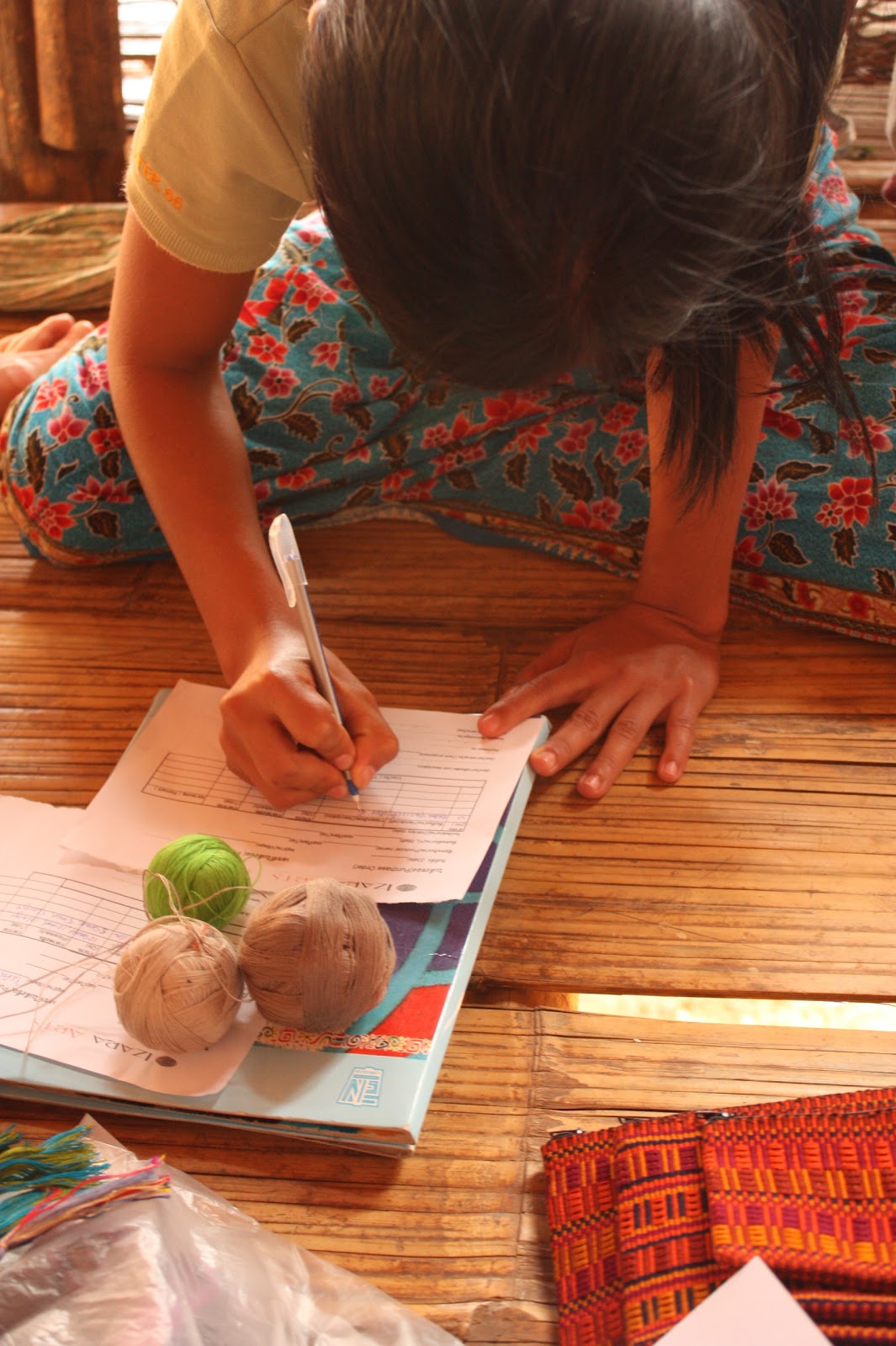
We recently headed out to Ya Fu, a Lahu village about 35 minutes outside of Chiang Rai. Izara Arts started working with this village about two years ago after a brief visit and finding these great little wallets (in various sizes) among some of their other handicrafts. We worked with them to get the colors right and since then the product has taken off! We have introduced quite a few other organizations including Tammachat Natural Textiles and the Textile Museum of Canada.


We've been carrying our two current colors for a while now and are looking to update the options. Through the help of Paul Hancock, Director of Khom Loy Development Foundation, we picked out some new colors including a lime green/brown/tan combo and a blue/teal/yellow combo (pictured right) and ordered a total of 45 zippered wallets. The ladies agreed to drop them to our office in two weeks time, so we're looking forward to seeing the new products and increasing sales for this Lahu village.

Monday, March 28, 2011

Chiang Rai Fair Trade Store Updated!

Have you stopped by the Thai Tribal Crafts (TTC) Fair Trade Shop in Chiang Rai lately? If not, you'd better plan a visit. Harry Wathittayakul, Managing Director of TTC Fair Trade store in Chiang Rai has overhauled the store with a new look, tons of new products and a great new vibe. 

The store, which is open Monday thru Saturday 9 a.m. to 5 p.m., carries loads of local handmade products from place mats to yoga mat bags, lunch bags to purses, keychains to jewelry. The store has it all and is a one-stop shop for the best souvenirs the area has to offer. You'll find a nice selection of Izara Arts products as well. The Fair Trade store is located near the new clock tower next door to the popular new coffee shop, The Hub.

528/8 Prakarn Rd.
Tambon Wiang, Mueng District, Chiang Rai Province, 57000

Tuesday, March 22, 2011

Art Development Workshop

Last month Izara Arts was invited to lead an art workshop at The Build Project, a non-profit organization based in Mae Sot, Thailand. The Build Project works with young people from Burma to provide training and teach technology and vocation skills, along with Thai and English languages. The workshop, which consisted of 11 students, was held to encourage the students to think outside the box. In a largely conformist society, this is traditionally frowned upon. Izara Arts was invited to break the tradition and get the students creating. The students had also just finished two days of academic tests, so it was a welcome break from all the hard work. Andrea Fitzgerald, Executive Director, wanted them to relax a bit before they moved into their new premises the next day.

Patricia Solar, Director of Izara Arts, began the workshop with a conversation about the difference between art and crafts. Explaining what a Fair Trade Organization, like Izara Arts, does versus what an art museum might do. She and the students discussed self-expression, symbolism and color. 

Then, Patricia and Ashley, an IA volunteer, poured out bags full of "art items" and asked the students to create something! The art items consisted of anything from Q-tips to string and fabric scraps, screws to wire, Popsicle sticks to wine corks - things one may not normally see as art. It was pretty amazing seeing the young minds go to work.

The students worked at their projects for about an hour. Ashley talked to the students about all the different kinds of art that emerged from the creations: architecture, fashion, painting, sculpting, drawing....forms of art the students probably never thought they were capable of, but executed (and some, quite well!). 

After discussing all of the creations, almost all of the students agreed that creating their art made them happy and relaxed them...exactly the outcome IA had hoped for. The students felt comfortable with the idea of art, creating it and enjoying it. I think you could say our job here is done. For now.

Friday, March 18, 2011

Coming Up!

In just one week, Izara Arts will be participating in yet another ThaiCraft Fair in Bangkok. The ThaiCraft Association, which started in 1975, has more than 70 Fair Trade groups involved in the bi-monthly exhibition.

Izara Arts will be heading down to Bangkok for the fair, in full force with a load of products and marketing materials. If you're in the area, be sure you make your way there. If not, check out ThaiCraft's web site, as well as Izara Arts'.

Jasmine City Building, Bangkok, Thailand
3rd Floor Entrance of Sukhumvit 23
10 a.m. to 3 p.m.

Tuesday, March 1, 2011

Mae Sot Landfill Visit

Izara Arts works with several Thai, Burmese and Laotian minority groups promoting Fair Trade work. The organization is always looking for ways to increase its producer group and quality product range by providing fair wages for handicraft work. You can read more about our other producer groups here.


Last month, we took a trip to Mae Sot, Thailand, a town on the Burma/Thai border where tens of thousands of Burmese refugees live in the community, trying to make a life for themselves and their children. While there, we met with three different Burmese groups and commissioned them to start a few new projects for us. Izara Arts recently went on a little road trip to Mae Sot to catch up with some of our prospective producers.

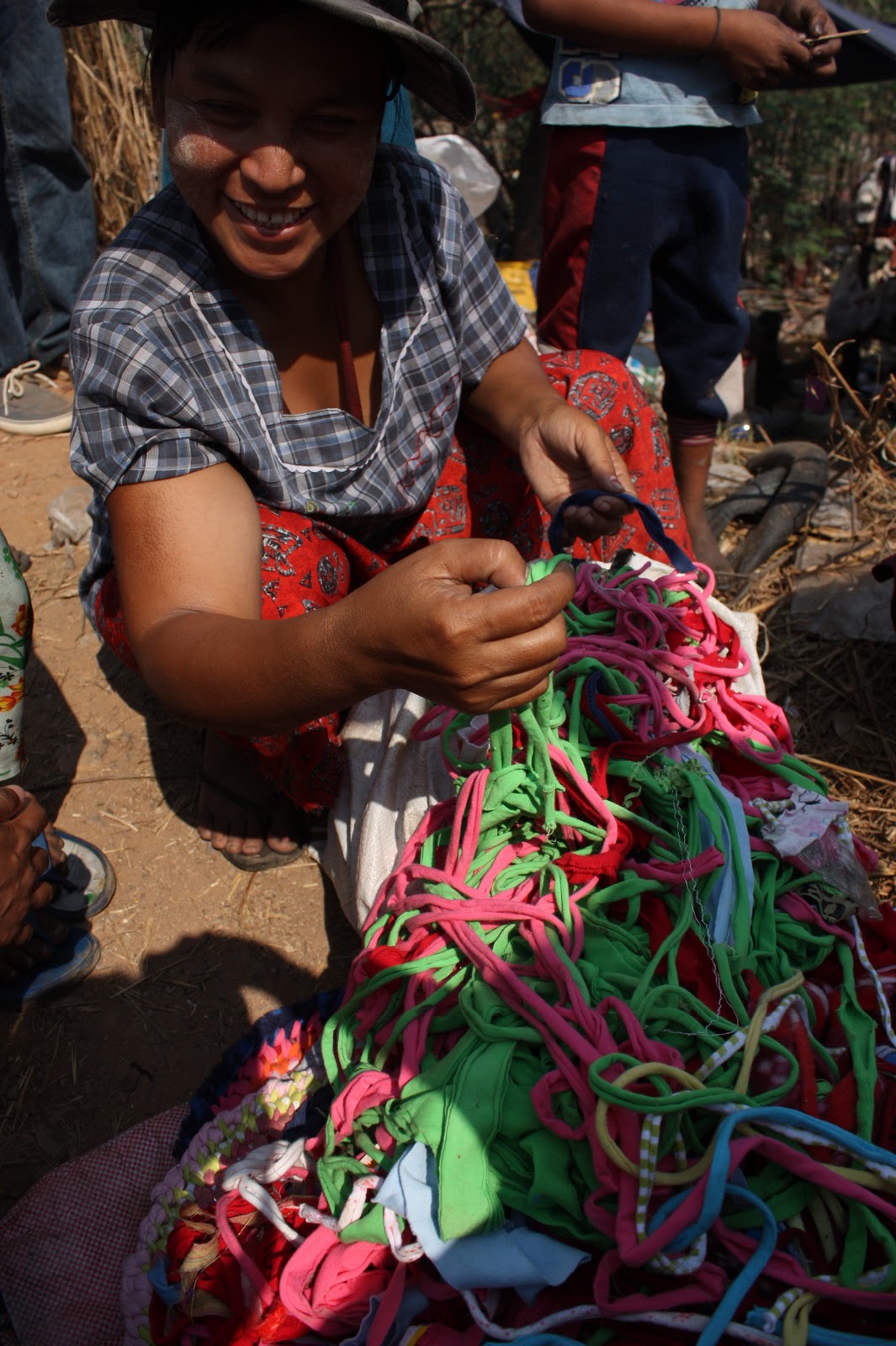
A newfound producer and her daughter standing next to their 
wonderful display of rugs made from scraps at the dump.
Our biggest surprise came from a woman who is currently living at the Mae Sot landfill. She is a mother of four who fled to Thailand for a better life for her children - even if that means living on a landfill. She and her daughter collect plastic bags and bottles out of the landfill, making only 70 baht per day. Two weeks ago Izara Arts showed a Burmese women in the local community an instructional video about making rugs from rags. IA supplied the materials and tools needed to make the first trial rugs. Then our 'new trainer' showed the women in the landfill how to weave rugs from fabric scraps easily found at the dump. We left her to see what she could do with no interference.  When we visited her, she had not only completed 10 rag rugs, but we could see a great product emerging.

Taking a look at the bag of fabric scraps.
Our next task was to talk business! We know she can find the scraps from the dump, but were made aware that local textile companies throw huge bags of scraps away weekly she could use, rather than having to dig through the landfill for them. She showed us her bag and she had tons of great colors to work with so we explained to her some different color options and styles of rugs. We bought 10 rugs from her upfront, to encourage a trusting relationship and asked her to make a couple more for the next day - using the information we told her about the colors and styles.

Explaining a color wheel and how some 
colors work together better than others.
Now that we've confirmed a producer, we have to find the market. We've been in contact with a few of the Fair Trade Shops in Mae Sot, the local market is going to be the best bet for selling them. We're also asking the local restaurants and guesthouses if they'd buy them for decor, as well as stock them in their establishment. Setting up a market for our new producer and making sure she'll have a viable income source from the rugs, she'll be able to get her and her family off the landfill and into a much safer and healthier lifestyle.

Tuesday, November 16, 2010

Fair Trade--'Are You Serious?' Case Study

Petra, our favorite volunteer!

Following the process, from artisans hard at work...


...to finished product!
My husband has a parable about his days as a consultant for Kaizen:


“What is the difference between involvement and commitment?” asks the earnest young consultant. “Ah”, says the wise old team leader, “did you have bacon and eggs for breakfast this morning? The chicken was involved, the pig was committed.”


We worked hard to get our membership from World Fair Trade Organization-Asia and beat the odds to do so. There are only 4 legitimately registered companies in Thailand, authorized to carry the Fair Trade logo on their products. We take seriously our commitment not to exploit the producers. Over the 7 years of our existence, we have driven down prices to normal wholesale levels. In some cases this meant taking 30% off the price of production. We’ve accomplished this without reducing the producers’ incomes or negotiating with them to bring their prices down.


This is not purely a philosophical position. As a business, we have the equal and opposite commitment of wanting to maximize profits. To reassure ourselves that we remain fair AND profitable we test our position occasionally so we can stand by the statements we make on our marketing material, to WFTO-Asia, to the producers and to the public.


The following blog is the report created by Petra Mackay, an Australian volunteer who visited us in October 2009. Unusually for a volunteer, she had some relevant understanding as she was studying ethnic communities in Southeast Asia at university. Importantly, she felt that she could live in an isolated village for 3-4 days without one word of the local language, which is much harder than it sounds.


We commissioned Petra to conduct a “time and motion” study to check whether we are in fact paying a fair amount for the work done. Since we had an observer in place, we asked her to comment on other questions. Have we just increased female workloads by bringing in the additional work, making them work longer hours in deteriorating conditions? Do the women have to hand the money over to the men thereby removing any discretion they might have about how it is spent?


Her report is fascinating. We attach it here in its entirety only removing the names for privacy. If anyone wants to commission work directly from the village, we are happy to make introductions and get out of the way. You will see from the report, that this particular village has good language skills and an understanding of the West.

Thai Craft Fair in Bangkok


Last weekend, Izara staff were able to visit Bangkok to sell at the monthly Thai Craft Fair on Sukhumvit Road.  Thai Craft has always given us excellent opportunities to get to know new customers, make friends, and increase our market in Bangkok. Check out pictures of our display and new packaging designs!

Wednesday, September 8, 2010

Izara Arts Background and Philosophy


After retiring from business careers in the UK and Canada, Patricia Solar and Paul Hancock created the Khom Loy Development Foundation a non-religious organisation working with indigenous people of Northern Thailand. We decided to use our own funds to support pilot projects designed to help hill tribe people get to grips with the modern money economy which is edging its way into their lives. Eventually, we settled on agriculture (food sustainability), education (preparing children for learning to stop the cycle of limited and poor education) and handicraft (income generation and job creation).

As the education and agriculture projects prove themselves, we look for additional funding but we decided that as a handicrafts business, Izara Arts had to stand alone as a viable business. We sell hill tribe products for a profit which is re-invested into the project and producers but we are a business first. Our focus must always be commercial because this is the way to maximize income for the producers in the long term. Running a charitable operation will increase dependency and does not build the women’s skills and confidence. In addition, projects dependent on charitable support can never grow as fast as those which are financially self-sustainable.

Beginnings
Our first effort was to sell what the women produced. This was a losing strategy because if the products had been desirable, they would already be selling. We learned that the techniques were the main selling feature but the designs were too “ethnic” and would never capture much of the market. So we brought in a designer to create some great modern patterns.

We then found that it took increasing numbers of trainers, supervisors and quality controllers to stabilise the output so there was still something not right. The women know how to produce. What they need from us is a link to the Western tastes and markets. We returned to developing our handicraft products as vehicles for their traditional techniques and patterns. We move the women back to old styles where the stitch work is smaller and more intricate than the casual tourist is willing to pay for, the techniques now only seen on formal personal outfits on special occasions.

Method
We take this undeniably beautiful, intricate work and use it with products that showcase it. We try to catch trends (like the yoga mat bag and the permanent shopping bags). We try to stay practical and relevant (eyemasks and baby products currently in production). We keep prices reasonable so the products move quickly and the women keep working. We put many different techniques onto each product so we maximize the number of jobs in each piece and make copying of our designs – always a problem in the handicraft world – more difficult. We introduce new products all the time because getting through the noise of the marketplace and connecting with a customer is the hardest part of the selling process. Once they know us and our quality, we keep giving them beautiful things to buy.
Philosophy

Thailand borders Laos, Cambodia, Vietnam, and Myanmar. In comparison to these countries, it is a developed nation and in fact is no longer on the underdeveloped nation list. In 1974, Khun Meechai began his condom promotion scheme. The birth rate dropped to 1-2 children per family from the previous 8+ at the same time as healthcare improved and child mortality dropped. These results have not extended to hilltribe villages.

Every developed country on earth has a falling birth rate while every underdeveloped nation has large families. When resources are finite (and when aren’t they?), no one can prosper when the pie keeps being divided into smaller and smaller pieces. Inevitability, when their children’s survival prospects improve, women choose smaller families. In addition, if the women can earn at home, they stay with their children instead of migrating to cities where their prospects are poor.

There is a link between female empowerment and economic development. Micro-credit schemes loan almost exclusively to women because they have a better understanding of money as an investment in the future. All women in our producer groups say that they want extra money to educate their children.

It is repeatedly proven in the developing world that women are the important change agents. Even in the developed world, small businesses are the real engine of jobs creation, not the big multi-nationals and small business startups are usually female. Viable businesses in the villages mean better lives for the villagers.